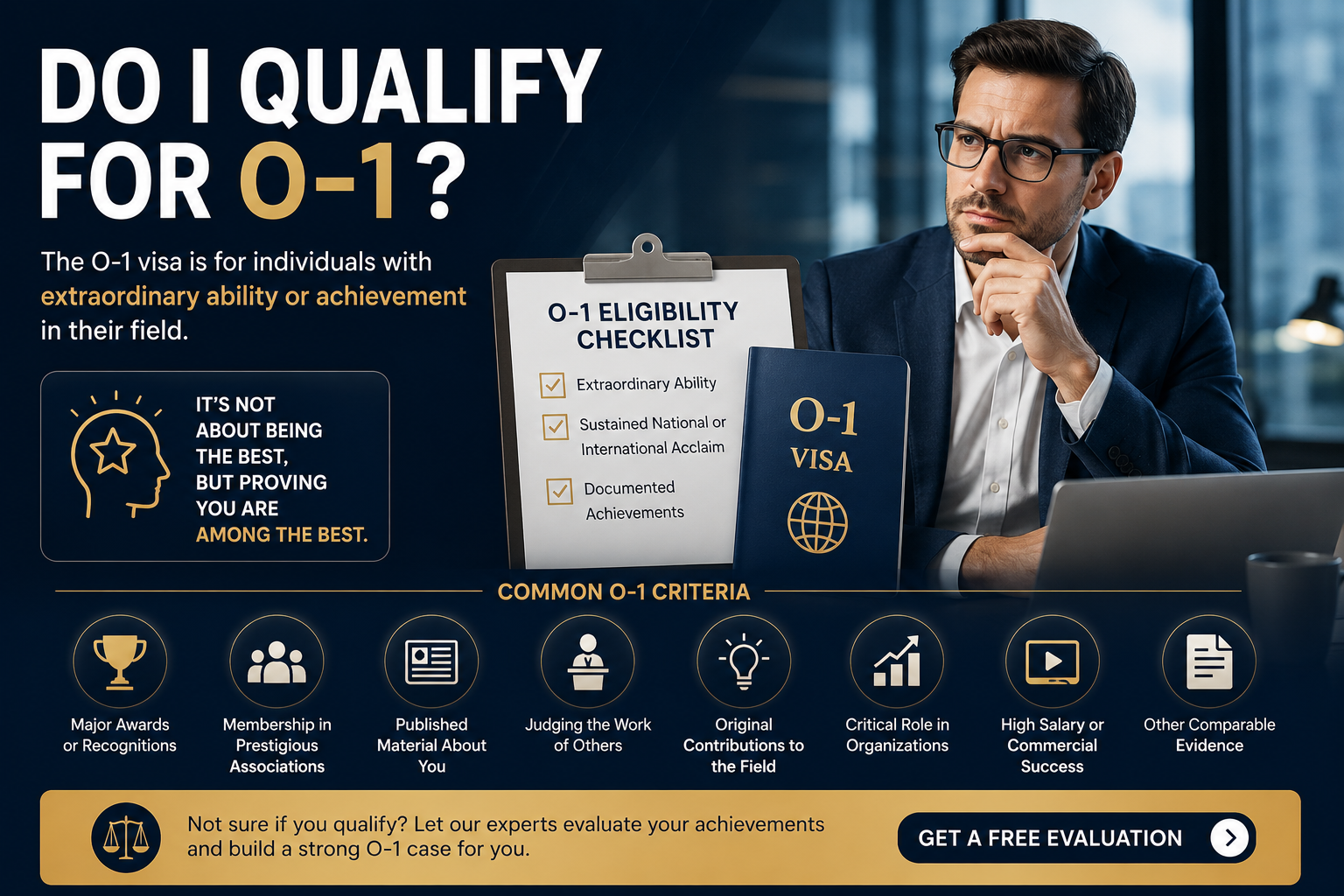
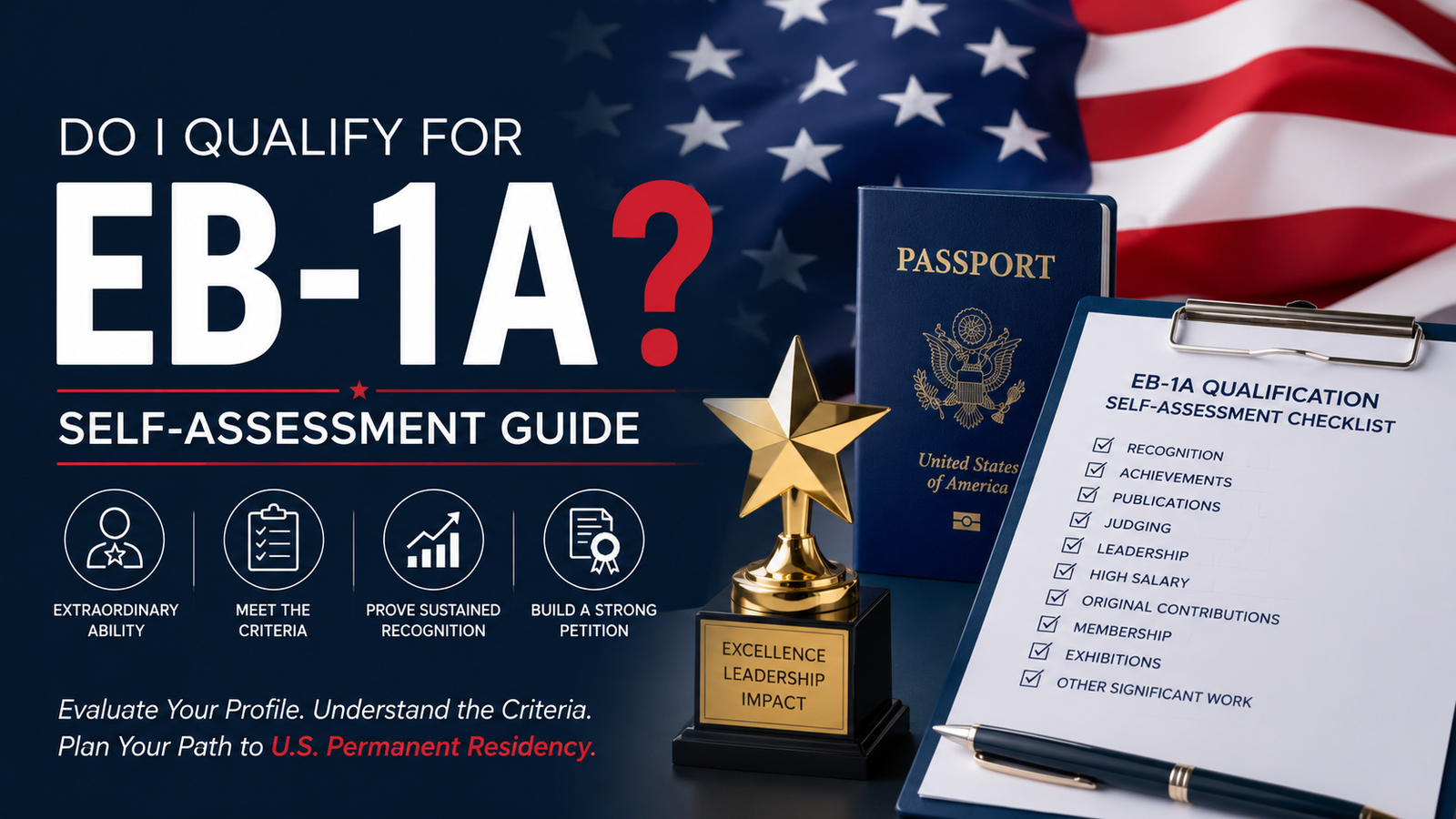
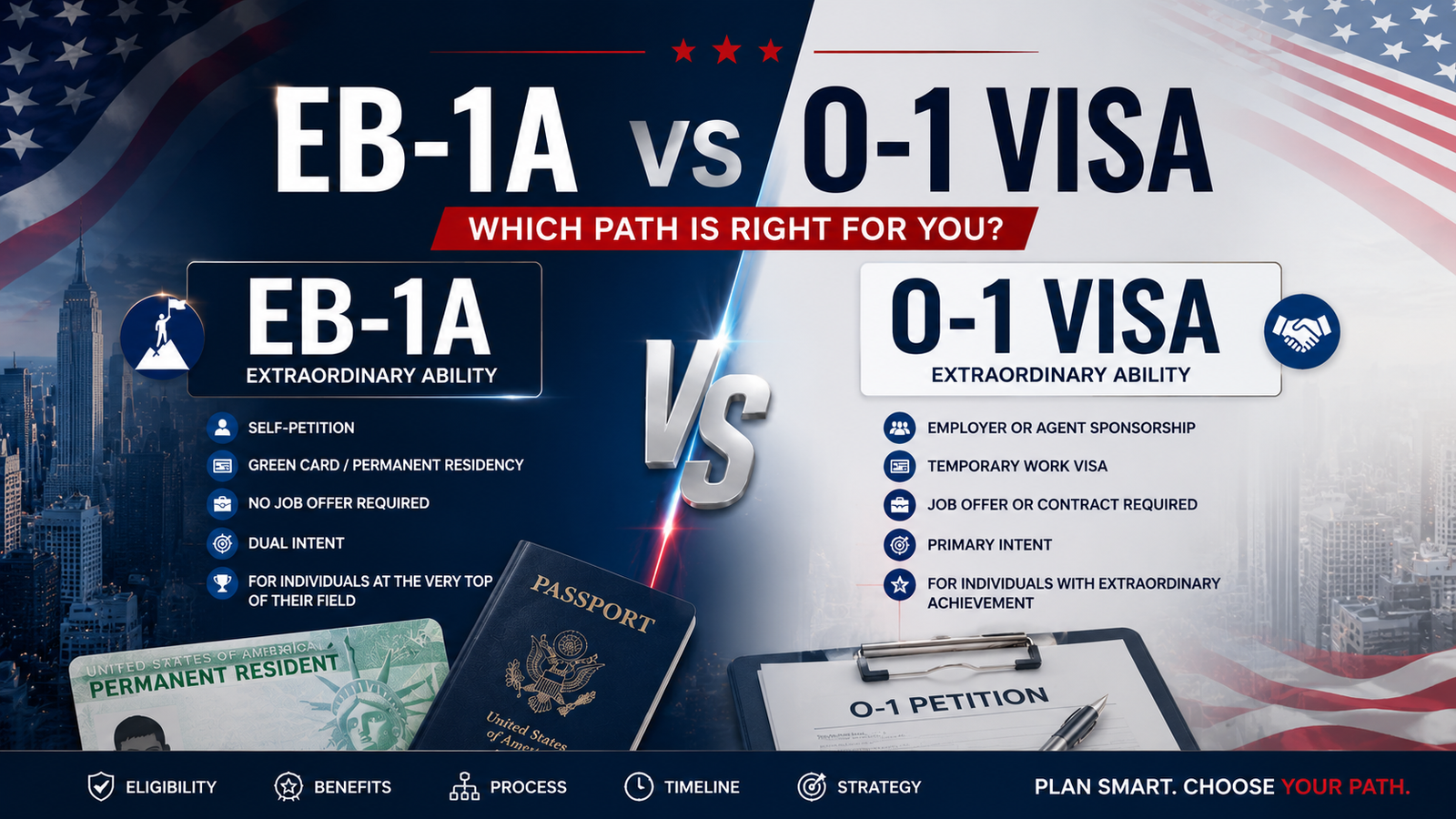
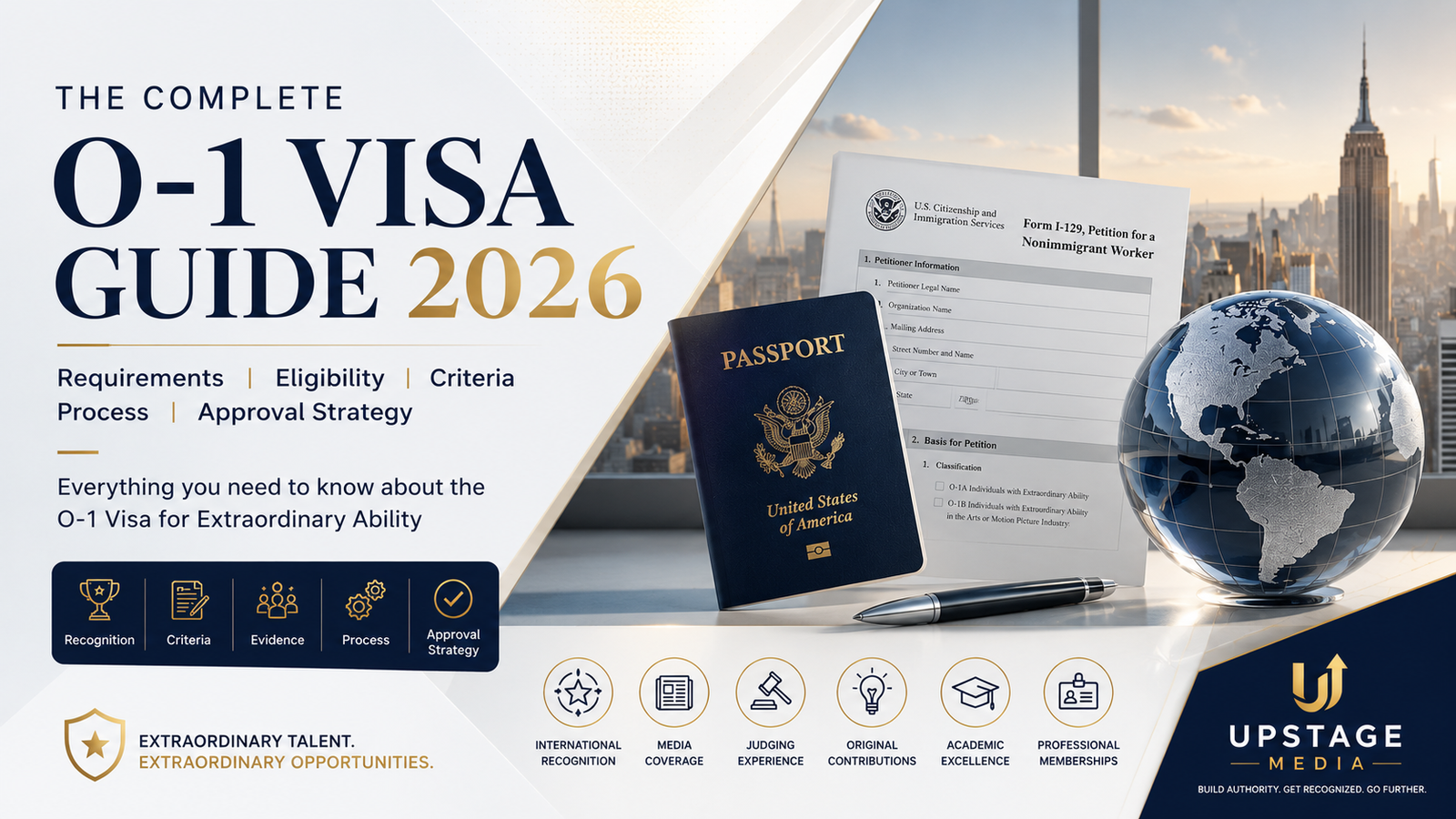
Do I Qualify for O-1?
A Self-Assessment Guide to the 8 Extraordinary Ability Criteria
If you’re asking “do I qualify for an O-1 visa,” you’re already asking a better question than most people who file. Many petitions fail not because the applicant lacks achievement, but because they never honestly tested their evidence against the actual legal standard before filing.
This guide walks you through that test. It won’t tell you what you want to hear — it will tell you how U.S. Citizenship and Immigration Services (USCIS) actually evaluates O-1 petitions, criterion by criterion, so you can score your own case before an officer does it for you.
This is educational content, not legal advice. Eligibility determinations depend on the specific facts of your case, and this guide cannot substitute for review by a qualified immigration attorney.
What "Extraordinary Ability" Actually Means
- The O-1 visa exists for people who have reached the very top of their field — not people who are simply skilled, accomplished, or successful by ordinary professional standards. USCIS defines the O-1A standard (science, education, business, athletics) as a level of expertise indicating the person is one of the small percentage who have risen to the very top of the field of endeavor.
That phrasing matters. It is not “top 10 percent.” It is not “well regarded.” USCIS is looking for evidence that separates you from your peers, not evidence that you are a strong performer among them.
The standard shifts slightly by category:
- O-1A (science, education, business, athletics): “extraordinary ability” — top of the field
- O-1B (arts): “distinction” — a somewhat lower bar, defined as skill and recognition substantially above what is ordinarily encountered
- O-1 (motion picture/television): “extraordinary achievement” — the highest bar of the three, requiring recognition as outstanding, notable, or leading in the industry
If you’re not sure which category applies to you, that’s the first thing to settle, because the evidence standard — and in some cases the specific criteria — differs between them. Someone building a case as a technologist should generally look at O-1A, even if their work has a creative or design component. Someone building a case as a working artist, designer, or performer typically falls under O-1B.
The Two-Step Test USCIS Actually Applies
Most self-assessment guides stop at “meet three of eight criteria.” That’s step one, not the whole test.
USCIS uses what’s commonly called the Kazarian two-step analysis, named after the federal court case that shaped how these petitions are adjudicated:
Step 1 — Counting criteria. The officer checks whether your evidence satisfies at least three of the eight regulatory criteria (or a single major internationally recognized award).
Step 2 — Final merits determination. The officer then steps back and asks whether the totality of the evidence — not just the checklist — actually demonstrates that you’re among the small percentage at the top of your field.
This second step is where many technically-qualifying petitions still get denied or receive a Request for Evidence (RFE). You can check three boxes with thin, generic, or poorly contextualized evidence and still fail step two. A self-assessment that only counts boxes is incomplete. A more useful self-assessment asks, for each criterion: would a skeptical officer, reading only this evidence, conclude I’m exceptional — or merely qualified?
Keep that question in mind as you work through the checklist below.
The One-Time Achievement Shortcut
Before working through the eight criteria, check whether you can skip most of this process entirely. If you hold a major, internationally recognized, one-time achievement — the classic examples are a Nobel Prize, an Olympic medal, an Academy Award, a Grammy, or a Pulitzer — that single achievement can independently establish extraordinary ability. Very few applicants fall into this category, but it’s worth ruling out first.
For most professionals, the path runs through the eight criteria below.
Self-Assessment: Walk Through the 8 O-1A Criteria
For each criterion, ask yourself the honest-scoring question, and note whether your answer is a clear “yes,” a “maybe, with more documentation,” or a “no.”
1. Receipt of nationally or internationally recognized prizes or awards for excellence
Honest test: Was the award competitive, and does it carry recognition beyond your own employer or a purely local context? A best-paper award at a major conference, an NIH or NSF career award, or a recognized industry award can count. An internal company award generally does not.
2. Membership in associations that require outstanding achievement, judged by recognized experts
Honest test: Did the association evaluate you against a rigorous standard set and judged by established experts in the field — or does membership simply require paying dues or holding a degree? Fellowship-level membership in a selective professional body is strong; general association membership usually is not.
3. Published material about you, in professional or major trade publications or major media, relating to your work
Honest test: Is the coverage about your work and its significance, written by an independent journalist or publication — not a press release, sponsored post, or piece you or your company authored? A profile in an industry trade publication discussing your specific contribution is strong evidence; a passing mention in a company blog is weak.
4. Participation as a judge of the work of others in your field or an allied field
Honest test: Have you formally reviewed, judged, or evaluated others’ work — peer review for a journal, serving as a judge for a hackathon or pitch competition, sitting on a grant review panel? One-off, undocumented instances are weaker than a documented, repeated pattern.
5. Original scientific, scholarly, business-related, or athletic contributions of major significance
Honest test: Can you point to independent evidence that your specific contribution changed practice in your field — citations, adoption by others, expert letters explaining the significance, measurable impact? This is often the criterion where self-assessment goes wrong: doing good work is not the same as having documented, attributable, major significance.
6. Authorship of scholarly articles in professional journals or major media
Honest test: Do you have publications in recognized venues for your field? Note that “scholarly” is interpreted broadly for STEM and business fields — this can include technical white papers, patents with accompanying evidence of significance, or substantive contributions to major industry publications, not only peer-reviewed academic journals.
7. Evidence of employment in a critical or essential capacity for organizations with a distinguished reputation
Honest test: Was your role genuinely critical to the organization’s core function or reputation, and is the organization’s distinguished reputation independently documented? “I worked at a well-known company” is not, by itself, sufficient — the case needs to show your role’s centrality and the organization’s standing.
8. Evidence that you command or have commanded a high salary or other significantly high remuneration
Honest test: Is your compensation demonstrably high relative to others in your field, supported by comparative wage data (such as Department of Labor or industry benchmarking sources)? For founders and entrepreneurs without a traditional salary, this criterion is often replaced with comparable evidence — see below.
Score yourself honestly across all eight. If you land on three or more genuine “yes” answers with real supporting documentation, you likely have a foundation worth building on. If you’re at zero or one, an O-1 petition filed today is unlikely to succeed, and your energy is better spent building evidence over the next 12–24 months than filing prematurely.
Comparable Evidence: When the Standard Criteria Don't Fit
USCIS recognizes that the eight criteria were written with certain professions in mind, and that they don’t map cleanly onto every field. Where a standard criterion “does not readily apply” to your occupation, you may submit comparable evidence instead.
Common substitutions include:
- Equity ownership or valuation milestones in place of a traditional high salary, for founders
- A keynote at a major industry conference in place of scholarly authorship, for practitioners rather than academics
- Selection into a highly competitive accelerator or fellowship program in place of association membership, where no formal association exists
- Product adoption metrics, user growth, or enterprise customer wins in place of citations, to show major significance of a contribution
Comparable evidence must still meet the same underlying purpose as the criterion it replaces — it has to independently demonstrate the same caliber of distinction, not simply check a box in a more convenient way.
A Note for Founders, Entrepreneurs, and STEM/AI Professionals
USCIS policy guidance issued in recent years has specifically clarified how officers should evaluate O-1A cases in critical and emerging technology fields, and has confirmed that founders, entrepreneurs, and researchers can qualify without following an academic publishing pattern. This is a meaningful development for people whose evidence looks different from a traditional scientist’s — product launches, funding milestones, technical leadership, and industry recognition can all be built into a competitive case when documented correctly.
A U.S. company — including one founded by the beneficiary — can act as the petitioner for an O-1, provided the petitioning entity is a legitimate business with the authority to control the terms of the beneficiary’s employment, and the arrangement is properly documented. This structure requires careful setup and is a frequent source of RFEs when the corporate and employment relationship isn’t clearly established, so it deserves particular attention if this applies to you.
Common Self-Assessment Mistakes
- Confusing being good at your job with being extraordinary in your field. Strong performance reviews and steady career growth are not, by themselves, evidence of the small-percentage standard.
- Relying on self-authored or company-authored material as “published material about you,” when USCIS is looking for independent, third-party coverage.
- Treating criteria as independent boxes rather than building a coherent narrative that expert letters and documentation tie together.
- Ignoring the “critical capacity” and organizational reputation requirements and assuming a well-known employer name is sufficient on its own.
- Filing based on potential rather than documented past achievement. O-1 eligibility is backward-looking — USCIS wants to see what you have already accomplished, not what you are likely to accomplish.
- Underestimating the importance of the itinerary and advisory opinion requirements, which are procedural but can derail an otherwise strong case if incomplete.
Fictional Case Study: A Self-Assessment in Practice
The following is a fictional composite created for illustrative purposes and does not represent an actual client or case.
Consider “Mei,” a machine learning engineer at a mid-sized AI startup. On first read, Mei assumed she didn’t qualify — she had no major awards and no peer-reviewed publications. Running the honest self-assessment above, however, she found she could document: judging role at two industry hackathons (criterion 4), a technical keynote at a major AI conference used as comparable evidence for authorship (criterion 6), a critical, well-documented role in her company’s core technology with independent press coverage of the product’s significance (criterion 7, plus contribution toward criterion 5), and equity holdings tied to a recent funding round used as comparable evidence for remuneration (criterion 8). Four criteria, honestly assessed and independently documented, gave her a foundation to move forward — something a surface-level “do I have an award?” check would have missed entirely.
What to Do If You Fall Short Today
An honest self-assessment that comes back weak is not a dead end — it’s useful information. If you’re not there yet, the highest-leverage next steps are usually:
- Build a documented record of judging or peer review, which is often the fastest criterion to strengthen
- Pursue speaking opportunities, editorial board seats, or professional memberships that carry genuine selectivity
- Seek independent media coverage of your work rather than company-published content
- Track and document impact metrics for your contributions as they happen, rather than reconstructing them later
- Revisit the EB-1A and O-1 side by side, since the evidentiary building blocks — awards, memberships, media, judging, original contributions — largely overlap between the two categories, so work done now can support either path later
Building profile evidence deliberately — through structured opportunities like professional memberships, editorial board placements, hackathon or competition judging roles, media features, and research publication support — is exactly the kind of work that turns a “maybe” self-assessment into a “yes” over the following 6 to 18 months.
Key Takeaways
- “Extraordinary ability” means the top of your field, not simply strong performance; self-assess against that bar, not against being a good employee.
- USCIS applies a two-step test: meeting three criteria is only step one; the final merits determination looks at the whole picture.
- Comparable evidence lets founders, entrepreneurs, and non-traditional professionals substitute for criteria that don’t fit their field.
- Meeting exactly three criteria narrowly is a weaker position than meeting four or five with strong documentation.
- A weak self-assessment today is a planning tool, not a rejection — most gaps can be closed with 12–18 months of deliberate evidence-building.
- This guide is educational; a qualified immigration attorney should review your specific facts before you file.
Conclusion
The honest answer to “do I qualify for O-1?” is rarely a simple yes or no — it’s a question of how strong your documented evidence is against a genuinely high bar, and how many of the eight criteria you can support with independent, well-explained proof. Running this self-assessment before you file, rather than after an RFE arrives, is the single highest-leverage thing you can do for your case.
If your self-assessment surfaced gaps rather than a clear “yes,” that’s normal, and it’s fixable. Upstage Media works with professionals across STEM, business, and research fields to build the documented record an O-1 or EB-1A petition depends on; from professional memberships and editorial board placements to media features, hackathon judging opportunities, and research publication support — so that when you do file, your case reflects the strongest possible version of your record.