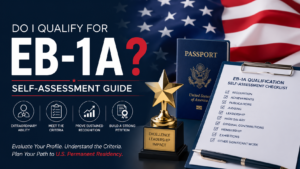
Do I Qualify for EB-1A?
A Self-Assessment Framework for Extraordinary Ability Green Cards
Every year, thousands of accomplished professionals ask a version of the same question: Do I actually qualify for EB-1A, or am I just a strong performer in my field? It’s a fair question, and it’s harder to answer honestly than most people expect. The EB-1A extraordinary ability green card doesn’t require a Nobel Prize or global celebrity — but it does require documented, comparative evidence that you stand out from your peers, not just that you’re good at your job.
This guide gives you a structured way to self-assess your profile against the same framework U.S. Citizenship and Immigration Services (USCIS) uses to evaluate petitions. It won’t give you a legal determination — no article can do that responsibly — but it will help you understand where your profile is strong, where it’s thin, and what to build before you file.
For the full breakdown of every criterion, evidentiary standard, and filing mechanic, see our companion resource, the complete EB-1A pillar guide. If you’re also weighing the O-1 visa as an alternative or interim step, the EB-1A vs. O-1 comparison guide walks through that decision in detail.
Quick Answer: Do You Qualify for EB-1A?
You likely have a viable EB-1A profile if you can document at least three of USCIS’s ten regulatory criteria with independent, verifiable evidence — such as competitive awards, media coverage of your work, a leading role at a recognized organization, or a record of judging others’ work – and your overall body of evidence tells a coherent story of sustained national or international acclaim in your field, not just isolated achievements. Meeting three criteria on paper is the minimum threshold; USCIS then evaluates the totality of your evidence in a second step before deciding whether it truly reflects extraordinary ability.
The Two-Part Test USCIS Actually Applies
A lot of confusion around EB-1A eligibility comes from treating it like a checklist: hit three boxes, get approved. That’s not how USCIS evaluates petitions. Since the Kazarian v. USCIS Ninth Circuit decision, adjudicators apply a two-step analysis, and understanding both steps is the foundation of any honest self-assessment.
Step 1 — The Threshold Determination. USCIS reviews your evidence against the ten regulatory criteria (or a single major, internationally recognized award, such as a Nobel Prize or Olympic medal, which alone can satisfy the threshold). You need documented evidence meeting at least three of the ten categories.
Step 2 — Final Merits Determination. This is where most self-assessments — and, frankly, many petitions — fall short. Even after clearing the three-criteria threshold, USCIS asks a broader question: Does the totality of the evidence show that you have risen to the very top of your field and sustained that acclaim over time? An officer can determine that three technically satisfied criteria still don’t add up to extraordinary ability if the underlying evidence is thin, dated, or not clearly tied to national or international recognition.
This is why counting criteria is only the first move. A realistic self-assessment has to ask not just “which boxes can I check” but “does my evidence, read together, tell the story of someone who is genuinely exceptional and internationally recognized as such?”
Self-Assessment Checklist: Work Through the 10 Criteria
Below are all regulatory criteria, reframed as direct questions. Answer honestly — the goal is an accurate read on your profile, not a flattering one:
- Nationally or internationally recognized prizes or awards Have you received an award or prize for excellence in your field that involved a competitive, merit-based selection process — not participation recognition? USCIS guidance now also permits team awards to count here, provided you can document your individually significant contribution to the team’s success and the award’s national or international stature.
- Membership in associations requiring outstanding achievement Are you a member of an organization that requires outstanding achievement, as judged by recognized experts, as a condition of admission — as opposed to membership that’s available for a fee or basic professional qualification? Recent USCIS clarifications also allow past memberships to count, not only current ones, which is useful if your qualifying membership has since lapsed.
- Published material about you and your work in professional or major trade publications or major media. Has media, trade press, or a professional publication written about you and your work — not content you authored yourself? Bylines, interviews profiling your work, and press coverage of a launch or discovery you led all fit here; op-eds you wrote generally don’t.
- Judging the work of others Have you served as a peer reviewer, competition judge, grant panelist, thesis committee member, or similar evaluator of others’ work in your field, individually or as part of a panel?
- Original contributions of major significance Have you made a scientific, scholarly, artistic, athletic, or business-related contribution that has had a demonstrable, field-level impact — evidenced by citations, adoption of your methodology, licensing of your innovation, or independent expert commentary on its significance?
- Authorship of scholarly articles: Have you authored articles in professional or major trade publications or other major media, appropriate to your field? This is one of the more straightforward criteria for researchers and academics, but note it addresses authorship — not the impact of that work, which typically needs to be shown separately under criterion five.
- Display of your work at artistic exhibitions or showcases. Primarily relevant to artists: has your work been displayed at exhibitions or showcases? USCIS guidance clarifies that non-artistic “exhibitions” can sometimes be considered as comparable evidence, but only where properly supported — this criterion remains strongest for visual and applied artists.
- Leading or critical role in distinguished organizations Have you held a role where your individual contribution was clearly essential to the organization’s reputation or outcomes — not simply a senior title? USCIS looks for evidence connecting your specific actions to measurable organizational results, not just a job description.
- High salary or remuneration relative to others in the field Does your compensation significantly exceed what others in your field typically earn, supported by comparative wage data (such as Department of Labor statistics) for your occupation and region?
- Commercial success in the performing arts. Primarily relevant to performing artists: can you show commercial success through box office receipts, sales figures, streaming data, or similar quantifiable measures?
Scoring Your Profile: What "Meeting Three" Really Requires
Checking three boxes on a list and having three defensible criteria are different things. As you go through the checklist above, apply this filter to each “yes”:
- Is it independently verifiable? Third-party documentation (award announcements, membership records, published articles) is far stronger than self-reported claims or internal company recognition.
- Is it clearly tied to national or international recognition — not just local or organizational? A “top performer” award scoped to a single company’s internal review process rarely satisfies USCIS the way an industry-wide, competitively selected award does.
- Can you explain, not just assert, why it matters? Officers are generalists. If you’re relying on a membership or award, you need to show the admission or selection standard, not assume the reviewer already understands your field’s internal hierarchy of prestige.
- Is it recent enough to support “sustained” acclaim? A single achievement from a decade ago, with nothing since, tends to weaken a claim of ongoing extraordinary ability rather than support it.
A useful rule from experienced petition strategists: two or three criteria supported by dense, independently verifiable documentation consistently outperform five or six criteria supported by thin or generic evidence. Depth beats breadth at this stage.
Profile Strength Framework
Use this framework to place your current profile — not where you hope to be, but where the evidence actually stands today.
Strong — Ready to Build a Petition You can document three or more criteria with independent, dated evidence, and your career shows a clear pattern of field-level recognition: awards from competitive, external bodies; media coverage tied to specific accomplishments; a leading role with measurable outcomes; or a body of published, cited work. Composite example (fictional): A biomedical researcher with two competitively awarded research grants from national funding bodies, service as a peer reviewer for two journals in their field, and coverage of their published findings in an industry trade publication.
Developing — Close, But Evidence Gaps Remain You can plausibly argue two criteria and have a partial case for a third, but the documentation is thin, dated, or hard to independently verify — for example, a leading role without clear evidence of the organization’s distinction, or a media mention that references your company rather than your individual contribution. Composite example (fictional): A software engineering lead with strong internal performance reviews and one conference speaking credit, but no independent press coverage, no competitive awards, and no documented judging or peer-review activity yet.
Not Yet — Build Before You File You have strong professional accomplishments but little to no evidence that maps to USCIS’s specific evidentiary categories — for example, consistent promotions and positive performance reviews within a single company, without external, field-wide recognition. This is a very common starting point, not a disqualification. It typically means investing 6–18 months in deliberate evidence-building: pursuing a qualifying professional membership, seeking peer-review or judging opportunities, or securing media coverage tied to a specific, attributable achievement.
If your honest self-assessment lands in “Developing” or “Not Yet,” that’s useful information, not bad news — it tells you exactly which categories of evidence to prioritize before filing, rather than filing prematurely and receiving a Request for Evidence (RFE) or denial.
Common False Positives: What People Think Counts (But Usually Doesn't)
- Being the best employee at your company. Internal recognition, without external, field-wide validation, rarely satisfies USCIS on its own.
- Paying to join a professional association. Membership criteria require that outstanding achievement, judged by recognized experts, was a condition of admission — dues-based membership generally doesn’t qualify.
- Writing articles about your own work. Self-authored content can support the “scholarly articles” criterion, but it does not satisfy the “published material about you” criterion, which requires third-party coverage.
- A high salary alone, without comparative data. You need documented evidence — typically government wage statistics for your occupation and region — showing your compensation is significantly above the norm, not just a belief that you’re well paid.
- A senior title without documented impact. “Leading role” evidence needs to connect your specific actions to the organization’s outcomes or reputation, not just describe your job responsibilities.
If You Don't Qualify Yet: The Pathway Forward
A “Not Yet” or “Developing” result is common, especially for professionals early or mid-career. The path forward is usually a deliberate, 6–18 months evidence-building phase rather than an indefinite wait. This is where structured profile development — securing peer-review roles, pursuing qualifying professional memberships, building relationships with trade media, or contributing to research with measurable field impact — turns a developing profile into a filing-ready one.
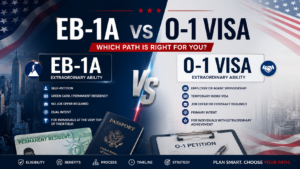
This is also the point at which many professionals evaluate the O-1 visa as a parallel or interim option, since it shares similar (though not identical) evidentiary categories but operates on a different framework and timeline. Our EB-1A vs. O-1 comparison guide breaks down when each category makes more sense, including for readers who may qualify for one now and the other later.
Upstage Media works with professionals at every stage of this self-assessment — including those who land squarely in “Developing” or “Not Yet” — to identify realistic evidence-building opportunities such as editorial board placements, hackathon judging roles, industry award nominations, and media features, each mapped to the specific USCIS criteria they’re designed to support.
Key Takeaways
- EB-1A eligibility is a two-step test: meeting three of ten criteria is only the threshold; the final merits determination evaluates your evidence as a whole.
- Depth of evidence within two or three criteria typically outperforms shallow evidence spread across many.
- Common false positives — internal recognition, dues-based memberships, self-authored articles, unsupported salary claims — often feel like qualifying evidence but usually aren’t.
- A “Developing” or “Not Yet” self-assessment is common and usually addressable through 6–18 months of deliberate evidence-building.
- EB-1A requires no employer sponsorship, no labor certification, and no formal degree — eligibility is evidence-based, not credential-based.
Conclusion
Figuring out whether you qualify for EB-1A isn’t about matching yourself to a single definition of “extraordinary” — it’s about honestly mapping your documented accomplishments against USCIS’s specific evidentiary framework and being realistic about the gaps. Most strong petitions aren’t built by people who checked every box from day one; they’re built by professionals who ran an honest self-assessment, identified exactly which criteria needed more evidence, and closed those gaps deliberately before filing.
If your self-assessment leaves you uncertain — whether you’re squarely in “Strong” territory or still building toward it — Upstage Media helps professionals translate real accomplishments into the kind of documented, verifiable evidence USCIS is looking for, from securing peer-review and judging opportunities to building media coverage and professional recognition tied to your specific field. Speak with our team to get a candid, criteria-by-criteria read on your profile before you file.
This article is provided for educational purposes only and does not constitute legal advice. EB-1A eligibility determinations depend on case-specific facts; consult a licensed immigration attorney before making filing decisions.